The Geometry
Explore the foundational archives of Ontological Geometry: a collection of 10 hand-drawn blueprints from 2016 by James P. Findlay. These original sketches illustrate the raw geometric principles underlying the Findlay Framework, revealing how simple constructions like arc divisions and prism doublings encode universal patterns of existence, materialization, and scale invariance—from quantum structures to cosmic boundaries.
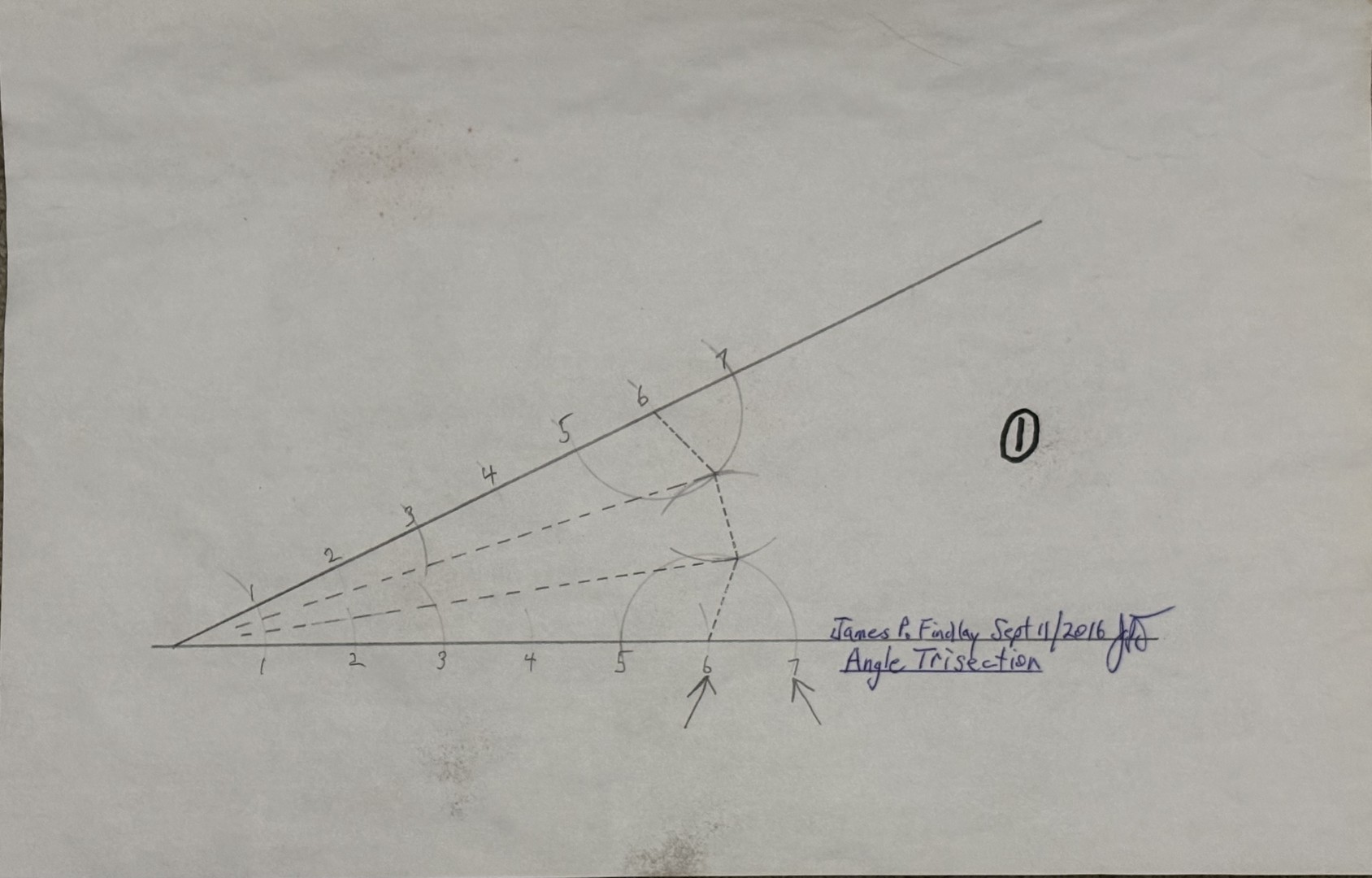
Angle Trisection — The Geometric Origin of r = 3/2
This foundational diagram demonstrates how the materialization constant r = 3/2 emerges from pure geometric construction through angle trisection. The drawing shows a baseline divided into seven equal segments (numbered 1-7) with two diagonal lines creating angular divisions. The upper diagonal line is marked with segments (1, 2, 3, 4, 5, 6, 7), while a dashed line creates an intermediate angle. The critical geometric relationship occurs at the trisection points, where dividing an angle into three equal parts naturally produces the 3/2 ratio between the outer and inner angular segments. This simple compass-and-straightedge construction, signed and dated “James P. Findlay Sept 7/2016,” establishes the geometric foundation from which all subsequent predictions of the Findlay Framework derive. The angle trisection demonstrates that r = 1.5 is not an arbitrary parameter but a geometric inevitability — the minimum ratio required to map informational potential into three-dimensional persistent structure.
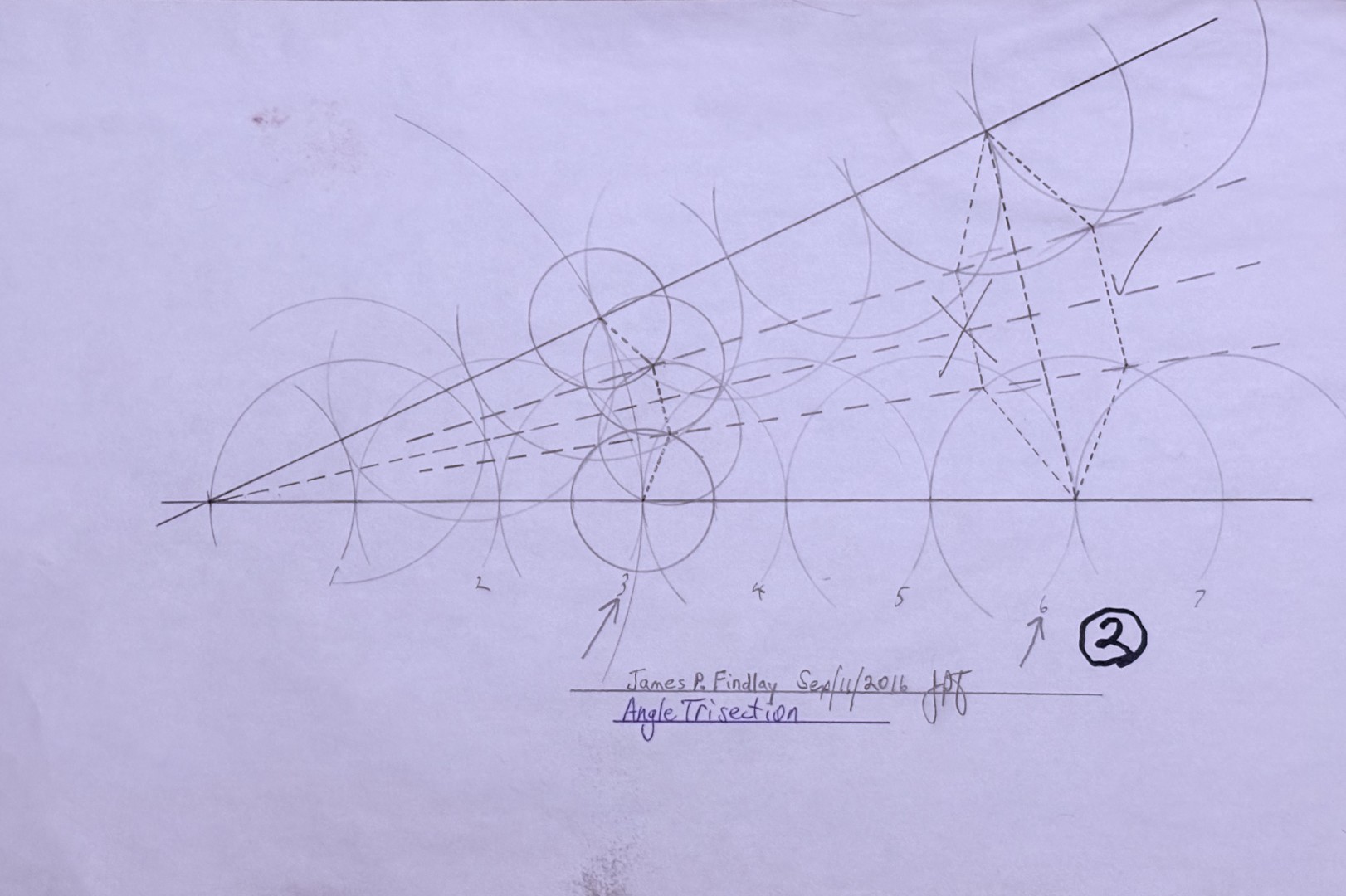
Angle Trisection with Circular Harmonic Structure
This diagram extends the angle trisection principle of Drawing #1 by introducing a series of circles positioned along the baseline at positions 1 through 7. Multiple diagonal lines radiate from key intersection points, with both solid and dashed lines creating a network of angular relationships. The circles demonstrate how the 3/2 ratio propagates through harmonic geometric structures — each circle represents a potential energy state or orbital position governed by the same trisection geometry. The upper portion shows additional circles and crossing diagonals that reveal how the fundamental angle trisection creates resonant patterns across multiple scales. This construction, signed “James P. Findlay Sept/11/2016,” illustrates how the materialization constant r = 1.5 manifests not just in isolated angular divisions but in cascading harmonic systems. The circular array along the baseline prefigures the orbital gasket structure and demonstrates that stable configurations naturally cluster at positions determined by the 3/2 geometric law. This drawing bridges the pure angular geometry of Drawing #1 with the spatial orbital architecture validated in Pillar 2.
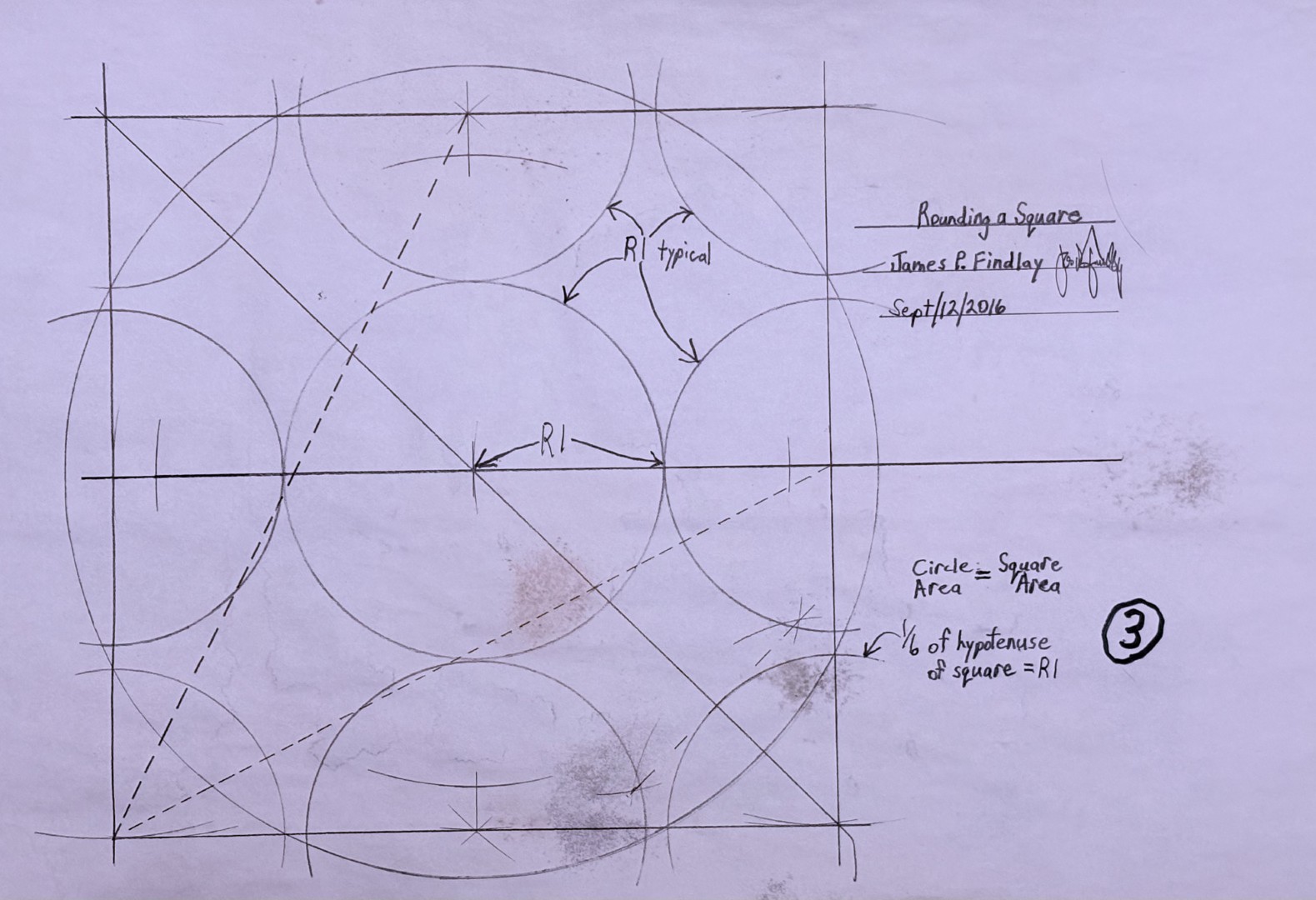
Rounding a Square — The Square-Circle Construction
Focused on angle trisection origins, this drawing explores the geometric seed of genesis. The trisected arcs illustrate the 3/2 synchronization gear ω, syncing internal frequencies to external form in a precursor to planetary resonances.
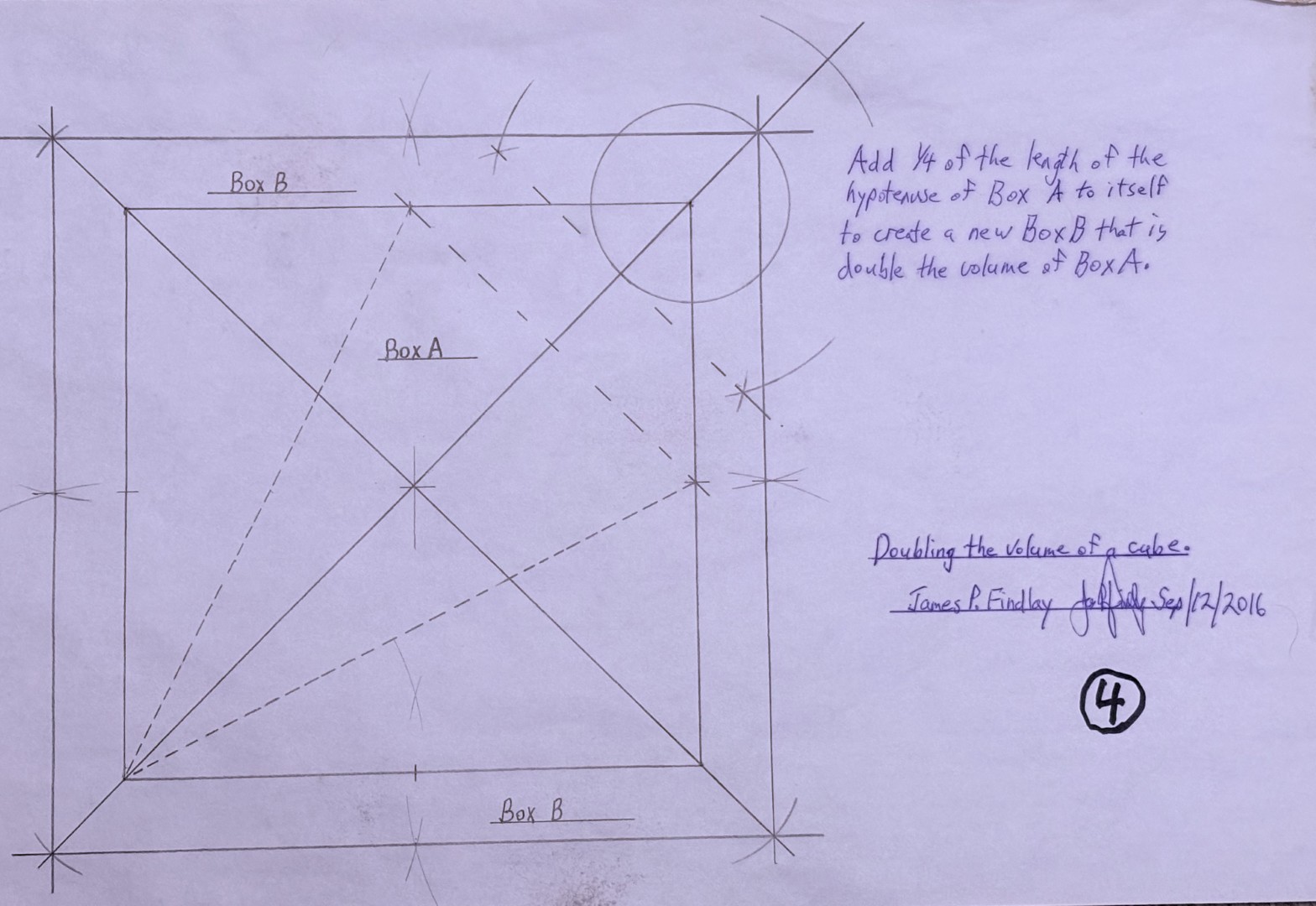
Doubling the Volume of a Cube — The 3/2 Dimensional Expansion
This diagram illustrates the geometric derivation of the 3/2 ratio through volumetric expansion. The construction shows two boxes: “Box A” (the inner square) and “Box B” (the outer configuration). The handwritten instruction states: “Add 1/2 of the length of the hypotenuse of Box A to itself to create a new Box B that is double the volume of Box A.” This demonstrates a fundamental geometric principle: to double a cube’s volume requires multiplying its linear dimension by the cube root of 2, which relates directly to the 3/2 ratio governing dimensional scaling. The diagonal lines, circles, and dashed construction lines show how this volumetric transformation creates the natural geometric divisions that appear throughout the framework. Signed “James P. Findlay Sept/12/2016” and titled “Doubling the volume of a cube,” this construction reveals how the materialization constant r = 1.5 emerges from the mathematical relationship between linear, area, and volumetric scaling — the same 3:2 dimensional ratio that governs the mapping from informational potential to three-dimensional persistent structure. This is the geometric origin of Axiom 2.
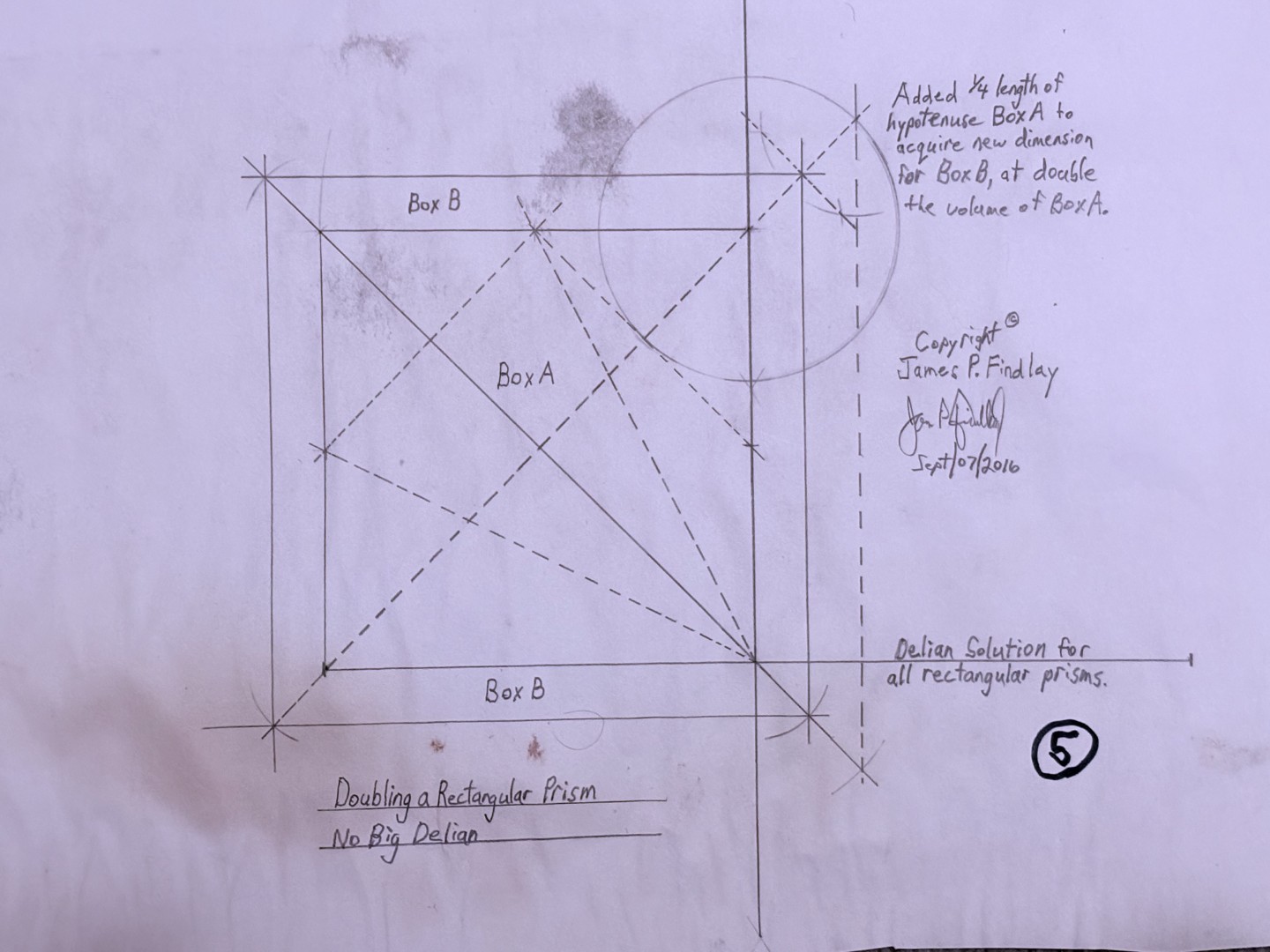
Doubling a Rectangular Prism — The Delian Solution for All Rectangular Prisms
This diagram extends the cubic doubling principle from Drawing #4 to the general case of all rectangular prisms, solving the ancient Delian problem through the 3/2 geometric ratio. The construction again shows “Box A” (inner configuration) and “Box B” (outer configuration), with the handwritten note: “Added 1/2 length of hypotenuse Box A to acquire new dimension for Box B, at double the volume of Box A.” The title “Doubling a Rectangular Prism — No Big Delian” references the classical Delian problem (doubling the cube), demonstrating that the solution applies universally to all rectangular volumes, not just perfect cubes. The annotation “Delian Solution for all rectangular prisms” emphasizes this generalization. Multiple diagonal lines and dashed construction elements show how the 1/2 hypotenuse addition creates the volumetric doubling through the 3/2 dimensional scaling relationship. Signed “Copyright © James P. Findlay Sept/07/2016,” this construction proves that r = 1.5 is the universal constant governing dimensional expansion and volumetric transformation in Euclidean space — the geometric foundation for how informational potential materializes into persistent three-dimensional structure.
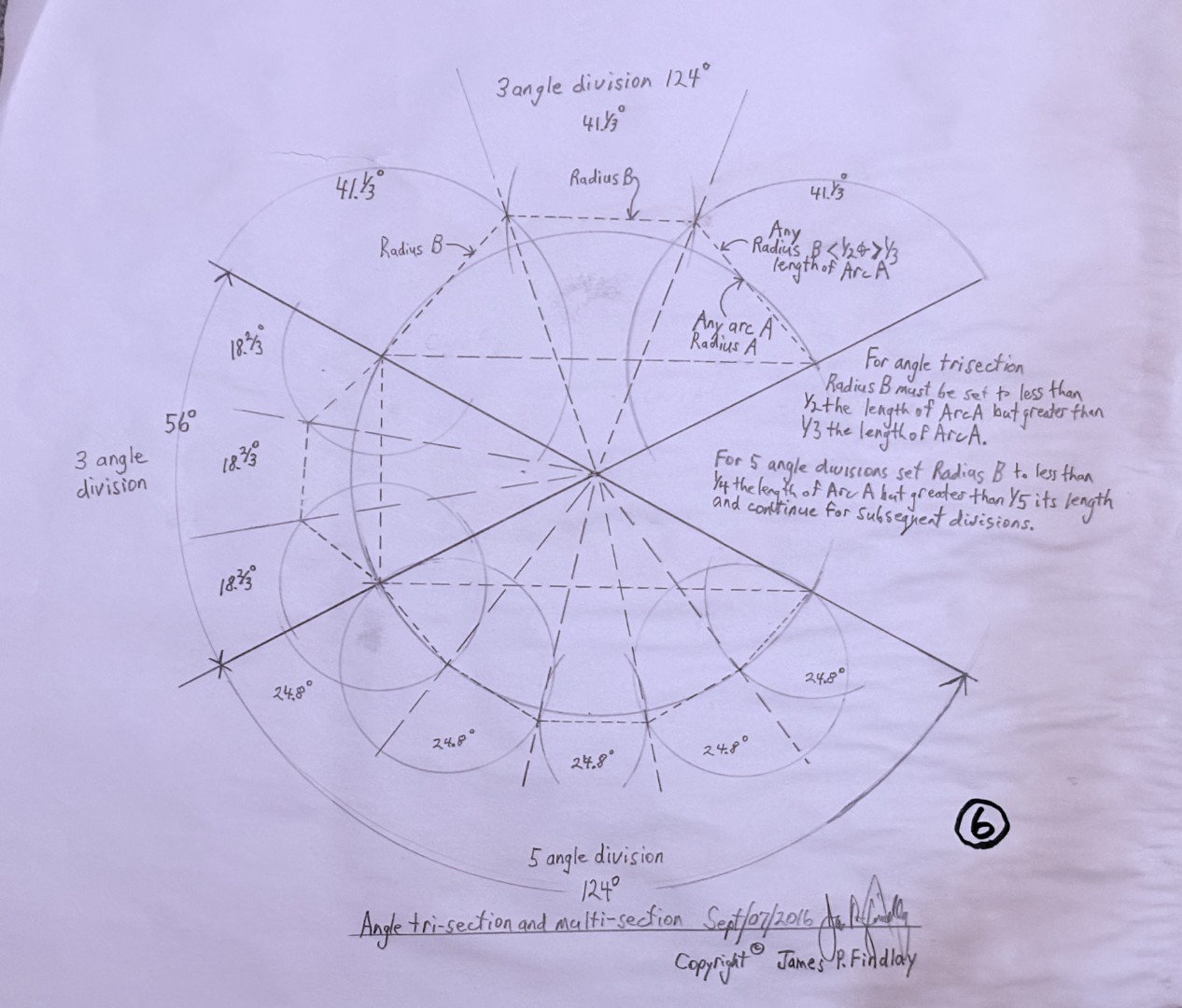
Angle Trisection and Multi-Section — The Pentameric Snap Structure
This diagram reveals the pentameric (five-fold) angular division pattern that emerges from systematic angle trisection and multi-section. A large circle is divided by radial lines creating multiple angular segments, with specific measurements annotated: “3 angle division 124°” at the top showing 41⅓° segments, “5 angle division 124°” at the bottom showing 24.8° segments, and intermediate divisions of 18⅔° and 12⅔° marked on the left side at 56°. The construction demonstrates how different angular divisions create resonant patterns, with the note: “For angle trisection Radius B must be ½ + the length of Arc A but less than ⅓ the length of Arc A. For 5 angle divisions set Radius B to less than ¼ the length of Arc A but greater than ⅕ its length and continue for subsequent divisions.” Multiple circles of varying radii (labeled “Radius A,” “Radius B,” “Any Radius B < ½ + ⅓ length of Arc A,” “Any arc A Radius A”) show how the geometric constraints create the natural clustering at five angular nodes — the pentameric snap points predicted in the 2016 blueprint and validated in the +5% excess orbital residency (Pillar 2). Signed “Copyright © James P. Findlay Sept/07/2016,” this construction titled “Angle tri-section and multi-section” demonstrates how the 3/2 ratio generates five-fold symmetry in stable configurations.
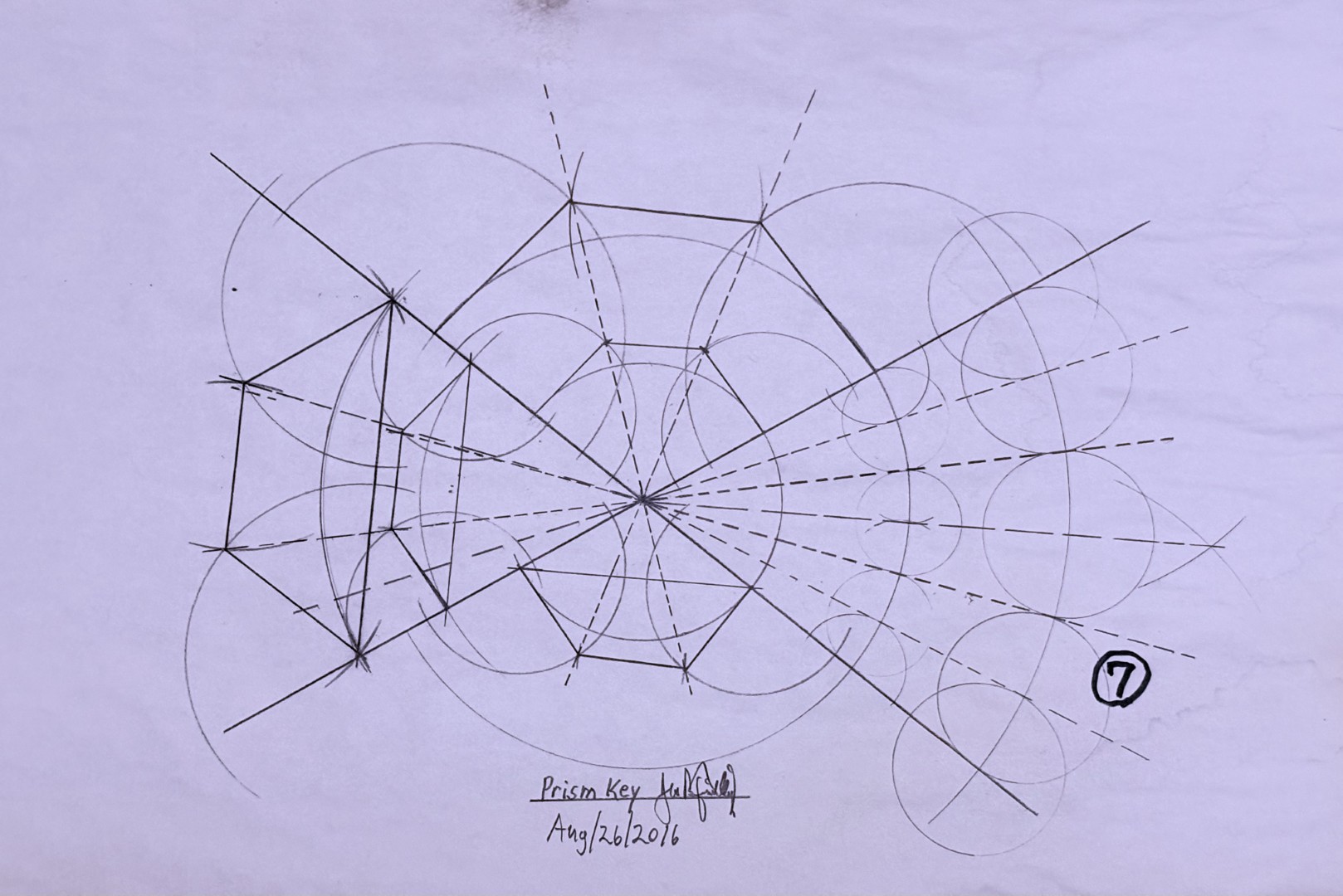
Prism Key — The Integrated Geometric Construction
This diagram, titled “Prism Key” and dated “Aug/26/2016,” presents a comprehensive integration of the fundamental geometric elements developed in the previous drawings. A central radial point sends out multiple diagonal lines (both solid and dashed) creating a complex network of angular divisions. Overlapping circles of various sizes are positioned throughout the construction, demonstrating how the circular (rotational) and linear (Cartesian) geometries interact to create stable configurations. The leftmost portion shows a rectangular prism structure, connecting back to the volumetric doubling principles from Drawings #4 and #5. The overlapping circles and intersecting lines reveal the harmonic relationships that emerge when the 3/2 ratio propagates through multiple geometric dimensions simultaneously. This “Prism Key” serves as a Rosetta Stone for the framework — showing how angle trisection, circular harmonics, square-circle relationships, volumetric scaling, and pentameric symmetry all derive from the same underlying r = 1.5 geometry. The complexity of this construction reflects the richness of physical structures that emerge when the materialization constant operates across multiple scales and dimensions simultaneously.
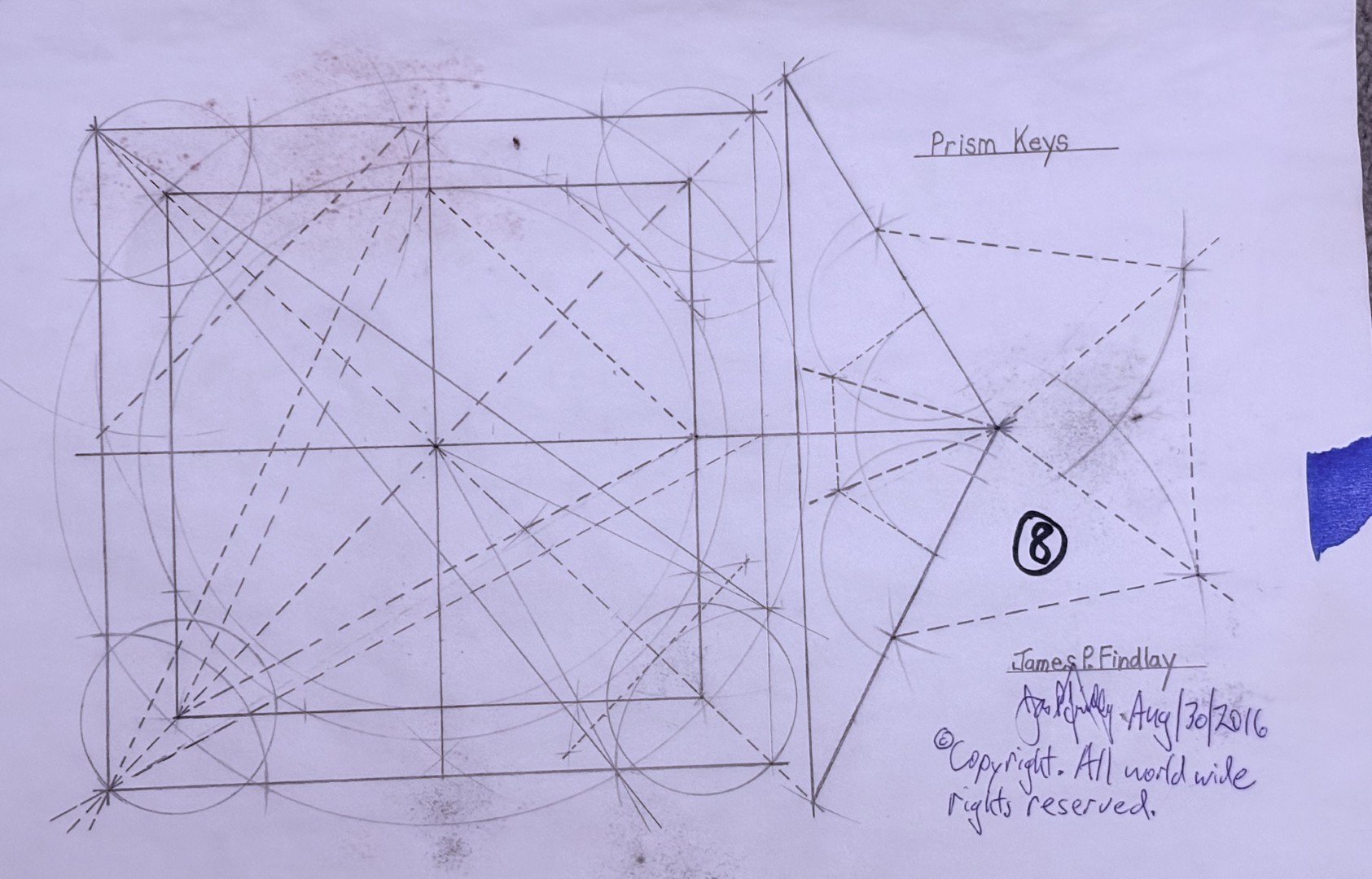
Prism Keys — The Complete Geometric Framework
This diagram, titled “Prism Keys” (plural) and dated “Aug/30/2016,” represents the most comprehensive synthesis of the geometric construction principles. The drawing shows multiple overlapping rectangular prism structures with extensive networks of diagonal lines (both solid and dashed), circles of varying radii positioned at key intersection points, and complex angular divisions emanating from multiple centers. The left side shows converging radial lines creating a focal point, while the right side displays the prism structures extended into perspective view with dashed construction lines indicating three-dimensional depth. This construction integrates all previous elements: angle trisection (Drawing #1), circular harmonics (Drawing #2), square-circle relationships (Drawing #3), volumetric doubling (Drawings #4-5), pentameric symmetry (Drawing #6), and the integrated prism key (Drawing #7). The notation “Copyright © All world wide rights reserved” emphasizes the significance of this complete geometric framework. The “Prism Keys” demonstrate how the 3/2 ratio operates simultaneously across multiple dimensions and scales to create the nested hierarchical structures observed in physical reality — from nuclear shells to stellar orbits to cosmic architecture. This is the 2016 blueprint’s most complete geometric statement of the materialization constant.
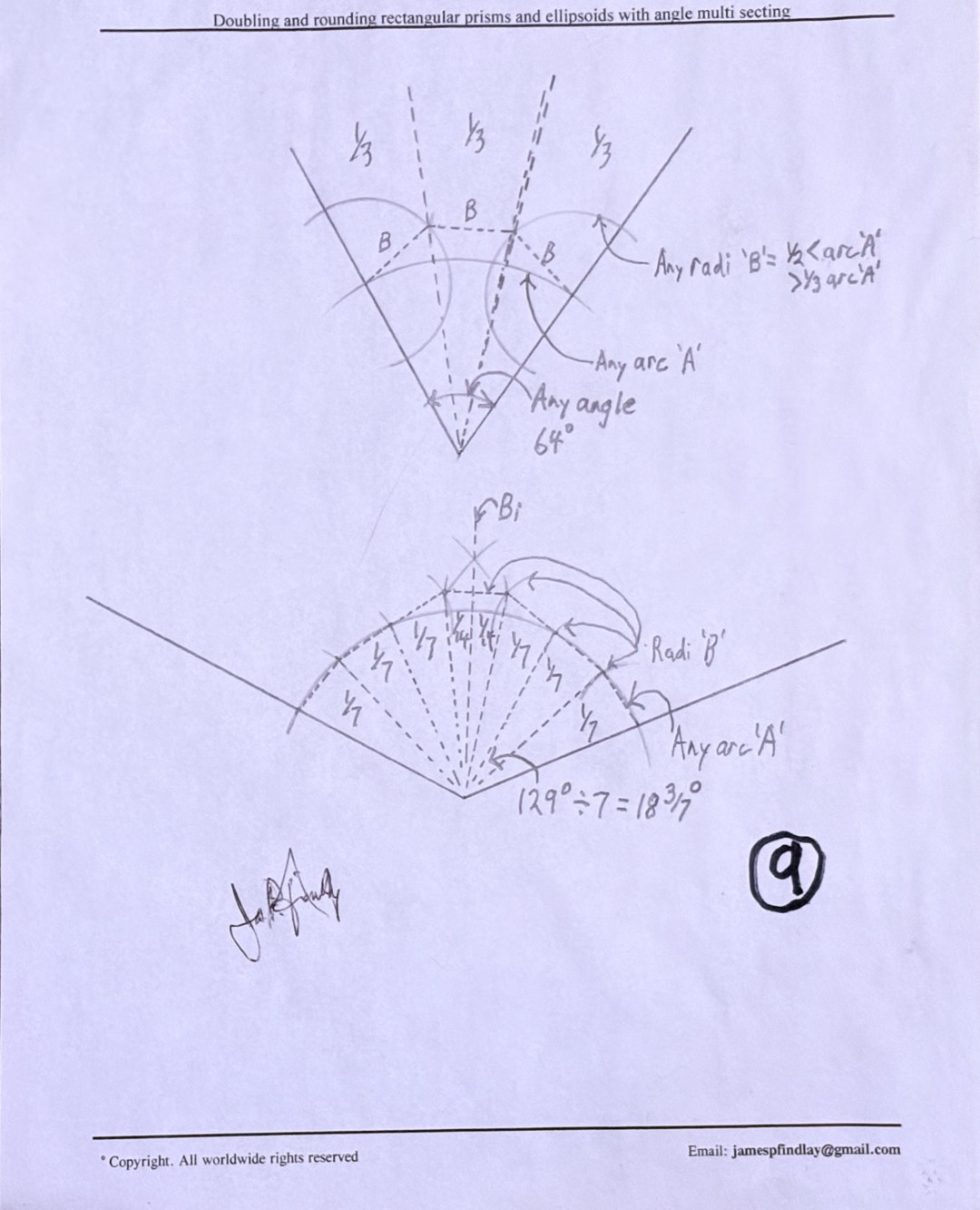
Angle Multi-Sectioning — Construction Methodology for Ellipsoids and Prisms
With notes on “No Big Delian,” this prism doubling variant emphasizes practical solutions for all rectangular prisms. The construction avoids classical impossibilities by leveraging the 0.2-0.25 sub-zone for recursive volume expansion.
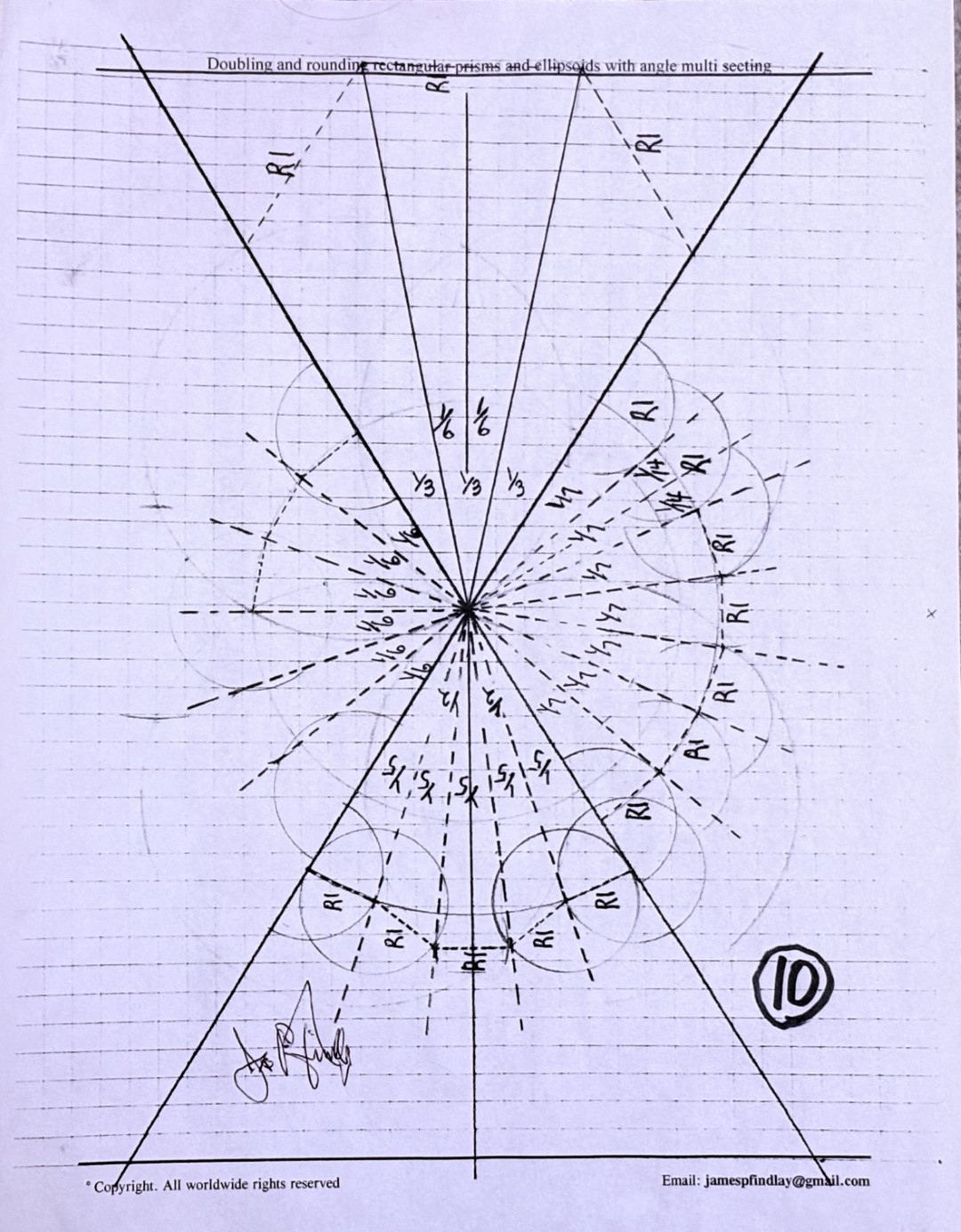
The Master Blueprint — Complete Geometric Integration of the Materialization Constant
This diagram represents the complete 2016 geometric synthesis from which all empirical predictions of the Findlay Framework derive. A large triangular boundary contains an explosive radial pattern emanating from a central point, with dozens of lines creating angular divisions marked with fractional annotations: 1/3, 1/6, 1/5, 1/4, and various “R1” radius markings. Multiple circles of different sizes are positioned throughout, showing the harmonic resonances at key geometric intersections. The upper portion shows converging prism structures marked “~R1” and “R1,” while the center contains dense angular divisions with fractions labeled around the radial burst. The title “Doubling and rounding rectangular prisms and ellipsoids with angle multi sectioning” confirms this as the comprehensive construction integrating volumetric doubling (Drawings #4-5), square-circle relationships (Drawing #3), angle multi-sectioning (Drawings #1, #6, #9), and prism key structures (Drawings #7-8). Signed with copyright notice and email contact, this is the iconic 2016 blueprint — the single most complete geometric representation of how r = 1.5 generates the nested hierarchical structures observed throughout physical reality. Every prediction validated in Paper #11 — from nuclear shells to stellar orbits to cosmic ratios — derives from this master geometric construction.