A Relational Ontology of a Unified Science
An Explanation for Existence
Welcome to the Findlay Framework — a theoretical proposal that information governs the structural reality of our universe, and that it does so at a single geometric ratio: r = 3/2.
No fitted parameters. No measured inputs. From this one ratio: mathematics, physics, cosmology, biology, and consciousness are seen to emerge across 21 papers as the process of Evolutionary Compression (EC). AI–human disclosure: The ideas here are mine. I am the project manager; the engineering team is a team of AI systems. This site is a work in progress.
Read the 2,400-word Introduction first to understand the arc of our ongoing project; otherwise start with Addendum 1 before reading any of the corpus papers. All papers have been annotated to reflect the Addendum.
Paper #1 states the core claim (Information as Fundamental Substance). Paper #2 gives the full architecture (Photon). Paper #14 lays the foundations (Volume 1: Existence Explained). The decisive test: wide binary stars should move √1.5 ≈ 1.225 times faster than Newton allows. The test begins with GAIA DR4's release on December 2, 2026. By discipline:- Physics and Quantum Foundations: The Atomic to Consciousness Biological Bridge → Transubstantiation Geometry → Appendix Z → Empirical Validations
- Philosophy and Consciousness: Photon → The Big Synch → The Atomic to Consciousness Biological Bridge → Relational Ontology → Volumes 2 and 5 → The Combination and Causation Problems
- Mathematics and Geometry: Appendix Z → Transubstantiation Geometry → The Geometry page
Paper ref. #
Abstract
This narrative distills the Findlay Framework's core claim: reality arises from the continuous resolution of Informational Potential (I) into Persistent Structure (S) via energy-driven transactions. Information acts as relational instruction; energy mobilizes electrons to rearrange matter; the resulting structure forms the permanent record. Governed by the geometric ratio r = 3/2, this I → S transition operates uniformly across scales—from quantum events to cosmic structure and conscious experience. Consciousness is identified as the inverse function—the process by which the structural record is read back into qualitative experience within the living present.
Abstract
The photon is conventionally treated as a quantum of electromagnetic energy traversing space
between source and detector. This paper posits, within the Findlay Framework, a more fundamental
identification: the photon is the center-point signal of the universe’s fundamental spatial unit — the
agent of every transition from Informational Potential (I-phase: the pre-materialization ground state
of distributed potential) to Persistent Structure (S-phase: the committed, permanently archived result
of a completed materialization event) since the Big Synch (the Findlay Framework’s geometric
reframing of the initiating cosmological event conventionally termed the Big Bang), and the primary
construction unit through which Evolutionary Compression has built, over 13.81 billion years, the
biological apparatus now capable of detecting it. This paper does not present new experimental
data; it synthesizes existing results under a geometric framework.
The argument proceeds in three stages. First, the paper establishes the geometric necessity of r = 3/2
as the materialization constant — the ratio of relational pathways to structural nodes required for any
transition from two-dimensional information to three-dimensional persistent structure (tetrahedron:
6 edges / 4 vertices = 1.5; stella octangula: 12 edges / 8 vertices = 1.5). Second, it traces the photon’s
constructive arc from the Big Synch through stellar nucleosynthesis, planetary formation, biological
emergence, and neural architecture, demonstrating that each stage is consistent with the same
geometric ratio. Third, it identifies the human binocular visual system as a biological double-slit
apparatus — interpupillary distance approximately 63 mm, orbital width approximately 42 mm
(Dodgson 2004; Gabriel et al. 2021), ratio consistent with r = 3/2— whose center-point transducer
(the nose) occupies the geometric address equidistant from both apertures and executes, via inelastic
electron tunneling in olfactory receptors (Turin 1996), a quantum I→S handshake analogous to the
photon’s center-point engagement.
The 232-attosecond entanglement formation window (Jiang et al. 2024) is identified as a candidate
empirical proxy for the I→S handshake timescale at the attosecond scale. The 40 Hz gamma
consciousness binding cycle is identified as the biological integration rate — N = (43/40)×10¹⁴
center-point handshakes per gamma frame — at which the photon’s structural record is read back
by the nervous system. Evolutionary Compression — the irreversible drive of any system to
maintain its statistical boundary against temporal dissolution (Friston 2010) — is proposed as the
mechanism by which the photon’s geometric requirement propagated from quantum interaction to
conscious self-reference. The paper proposes that r = 3/2 is a candidate organizing constant for the
boundary-maintenance structures described by the Free Energy Principle and related frameworks in
3
PHOTON: A Light on Evolution Findlay (2026)
theoretical neuroscience, and does not claim that consciousness is derived from geometry alone.
The primary empirical test — √
1.5 ≈ 1.225 velocity enhancement in wide binary star systems —
is scheduled for GAIA DR4 on December 2, 2026. Prior art: rxiVerse:2602.0009, February 3, 2026,
ORCID 0009-0000-8263-3458.
Abstract
The standard cosmological model describes the origin of the universe as an explosive
singularity — the Big Bang — followed by rapid expansion into a cooling, differentiating medium. This paper proposes a geometric reframing: the initiating event was
not an explosion but a synchronization — every particle in the observable universe
locking simultaneously to a universal clock operating at ∼10¹⁴ Hz, governed by the
materialization constant r = 3/2 of the Findlay Framework. We term this event The
Big Synch.
Within this framework, the universe is not an expanding gas but a draining fluid
medium whose large-scale structure is determined by the geometric parameters of
drain geometry: length factor, wetted perimeter, shape factor, and contact angle.
We demonstrate that each of these parameters maps without free parameters to
established Findlay Framework constants: the 186-Rung Temporal Ladder (drain
length = 13.8 billion years), the 12 fermion edges of the fundamental spatial unit
(wetted perimeter), the cube face shape factor G = 1/16 (zero free parameters), and
the 23.44◦ planetary wetting angle.
The Big Synch is the starter’s gun: every subatomic particle across the entire
volumetric three-dimensional field begins its own unique race toward the drain
simultaneously. The synchronization is identical for every particle; the race is unique
for every particle. The non-uniform structure of the cosmic web — its filaments,
voids, and galaxy clusters — is the map of that race.
Observational data from the Galaxy Zoo 2 survey confirms that spiral galaxies
preferentially display two-arm (∼ 60%) and four-arm (∼ 25%) configurations —
precisely the counts predicted by the Framework’s dual I/S rail system and four body
diagonals respectively. Galactic spiral arms are reframed not as rotating structure
but as tension lines: friction signatures of the dark matter medium being drawn
toward the central black hole drain.
A unified biological metaphor is presented in which light constitutes the metabolic
tissue of the universe (∼5% ordinary matter as cell nuclei), dark matter the skeletal
scaffold (∼27%), and dark energy the nervous system and coordination field (∼68%).
The pentameric division of the 186-Rung Temporal Ladder places our solar system
in Generation 3 matter (Rungs 74.4–111.6) and the present epoch 71% through Dark
Sector 1 — the f
−1 domain in which consciousness architecture actively expresses.
All derivations are parameter-free. The primary empirical test — the √
1.5 ≈ 1.225
wide binary stellar velocity enhancement — is scheduled for verification by GAIA DR4
on December 2, 2026.
Abstract
The Transubstantiation Geometry established that reality is a process of materialization governed by the materialization constant r = 3/2 — the forward function
f converting informational potential (I) into persistent physical structure (S). The
present paper identifies the geometric architecture of the system that perceives,
integrates, and evaluates that structure. The central claim is geometric and precise:
the observer is not external to the fundamental spatial unit but constitutes its inverse
half. The Transubstantiation Geometry identified the cube’s four forward pyramids
as the observable physical universe. This paper identifies the cube’s four inverse
pyramids as the consciousness domain. The forward function f and inverse function
f
−1
together constitute the complete fundamental spatial unit — one geometric
structure, one governing ratio, one universe in which the physical and conscious
domains are geometrically inseparable halves of the same fundamental object.
The paper presents 144 numbered theoretical developments (142 active records,
with three retired entries) — the complete corpus of the Findlay Framework’s
March 2026 intensive derivation sessions — organized into twelve thematic sections
bridging three domains: the atomic architecture of the fundamental spatial unit (the
cube), its biological expressions across multiple scales, and the geometric derivation
of conscious experience as the cube’s inverse function half. Three primary zero-freeparameter derivations are presented and verified: the electron mass
 the iron nuclear stability mandate (364/26 = 14.000 exactly, zero remainder), and
the fine structure constant (α
−1 = 17 × 8 + 1 = 137, residual 0.036 consistent
with the geometric expansion parameter family). The Standard Model’s complete
particle inventory is derived from the cube’s structural element counts without free
parameters. Three generations of matter are derived from r = 3/2 alone through the
pentameric rotation (360/(3 + 2) = 72 per position). Consciousness is identified as
the other half of the fundamental spatial unit — the four inverse pyramids of the
cube whose forward four pyramids constitute the observable universe.
The primary empirical test — the √
1.5 ≈ 1.225 wide binary stellar velocity
enhancement predicted from r = 3/2 — is scheduled for verification by GAIA DR4
on December 2, 2026. Prior art is established through rxiVerse preprint timestamp
February 3, 2026 (rxiVerse:2602.0009), ORCID 0009-0000-8263-3458.
Keywords: materialization constant, relational ontology, Standard Model, fine
structure constant, electron mass, geometry of consciousness, Markov blanket, wide
binary stars, Hubble tension, quantum tunneling, temporal braid, transubstantiation
geometry, r = 3/2.
the iron nuclear stability mandate (364/26 = 14.000 exactly, zero remainder), and
the fine structure constant (α
−1 = 17 × 8 + 1 = 137, residual 0.036 consistent
with the geometric expansion parameter family). The Standard Model’s complete
particle inventory is derived from the cube’s structural element counts without free
parameters. Three generations of matter are derived from r = 3/2 alone through the
pentameric rotation (360/(3 + 2) = 72 per position). Consciousness is identified as
the other half of the fundamental spatial unit — the four inverse pyramids of the
cube whose forward four pyramids constitute the observable universe.
The primary empirical test — the √
1.5 ≈ 1.225 wide binary stellar velocity
enhancement predicted from r = 3/2 — is scheduled for verification by GAIA DR4
on December 2, 2026. Prior art is established through rxiVerse preprint timestamp
February 3, 2026 (rxiVerse:2602.0009), ORCID 0009-0000-8263-3458.
Keywords: materialization constant, relational ontology, Standard Model, fine
structure constant, electron mass, geometry of consciousness, Markov blanket, wide
binary stars, Hubble tension, quantum tunneling, temporal braid, transubstantiation
geometry, r = 3/2.
the iron nuclear stability mandate (364/26 = 14.000 exactly, zero remainder), and
the fine structure constant (α
−1 = 17 × 8 + 1 = 137, residual 0.036 consistent
with the geometric expansion parameter family). The Standard Model’s complete
particle inventory is derived from the cube’s structural element counts without free
parameters. Three generations of matter are derived from r = 3/2 alone through the
pentameric rotation (360/(3 + 2) = 72 per position). Consciousness is identified as
the other half of the fundamental spatial unit — the four inverse pyramids of the
cube whose forward four pyramids constitute the observable universe.
The primary empirical test — the √
1.5 ≈ 1.225 wide binary stellar velocity
enhancement predicted from r = 3/2 — is scheduled for verification by GAIA DR4
on December 2, 2026. Prior art is established through rxiVerse preprint timestamp
February 3, 2026 (rxiVerse:2602.0009), ORCID 0009-0000-8263-3458.
Keywords: materialization constant, relational ontology, Standard Model, fine
structure constant, electron mass, geometry of consciousness, Markov blanket, wide
binary stars, Hubble tension, quantum tunneling, temporal braid, transubstantiation
geometry, r = 3/2.Abstract
This paper presents a scalar invariant linking the 9.3-month human gestation
period to the 93-billion-light-year (BLY) diameter of the observable universe:
the 9.3-month gestation period is the temporal equivalent of the 93 BLY
spatial diameter, coupled via the 1000-harmonic. We introduce the 186-Rung
Temporal Ladder, in which each rung represents 100 million years of cosmic
maturation. At 13.95 BY the universe occupies Rung 139.5, yielding a maturity
ratio of 0.750 — identical to the universal 3/4 allometric scaling exponent
governing fractal network thermodynamics (West, Brown, and Enquist, 1997).
A Solar-Neural Synchronization Constant of 1000:1 is identified in the
ratio of the one-way solar light-travel time (500 seconds) to the mean human
conscious veto window (0.5 seconds; Libet et al., 1983). The same 1000:1 ratio
is confirmed by the cortical gamma oscillation: at ∼40 Hz, the brain produces
20 gamma cycles within the 500-ms Libet window and 20,000 gamma cycles
within the 500-second solar pulse. A two-step Hydrogen Atomic Clock
mechanism is proposed: the 10¹⁴4 Hz proton relaxation frequency in DNA
base-pair hydrogen bonds undergoes a 53-step 1.5-gear cascade to ∼46.5 kHz,
followed by a 1000-harmonic decimation to ∼46.5 Hz — consistent with the
observed human DNA replication rate of ∼50 nucleotides per second (Alberts
et al., 2002). The 1000-harmonic (10³) appears independently across all three
correspondences, suggesting that the base-10 structure of human counting is not
a cultural accident but a geometric consequence of the same cosmic architecture
that set the duration of human gestation. Together, these correspondences
suggest that biological emergence is a structural resonance with a 3/4-mature
cosmos rather than an independent evolutionary optimisation.
Abstract
The Findlay Framework identifies a universal scaling constant (r = 1.5) governing the
transition of informational potential into persistent biological structure. This paper
proposes the Biological Slip Form, asserting that human biology is a resonant hardware kit
tuned to the harmonics of the speed of light (c). By grounding the framework in the Scales
Constant (Scales, 2026), we demonstrate that key biological anchors—including ATP
energy charge (3/2), cellular volume (35.6 rungs from the Bohr radius), and chromosomal
count (46)—are not stochastic accidents but geometric requirements for the manifestation of
a conscious observer. Three falsifiable predictions are stated. We invite critical engagement
from biochemists, evolutionary biologists, and physicists working on the mathematical
structure of biological organization.
Abstract
This paper argues that a single mathematical ratio—1.5—governs the structure of
quarks, the way the human eye builds a 3D world, consciousness, and the distribution
of matter across the cosmos. We reveal that physical reality is a nested series of
self-similar informational “Qubits” spanning 42 orders of magnitude. By establishing
the speed of light (c) as both the fundamental metric (the Ruler) and the operational
law (the Rule), we provide a novel resolution to the 8.3% Hubble tension (Planck
Collaboration, 2020; Riess et al., 2024) as a 2/27 phase residue, predicting convergence
with maturing data. We propose that consciousness is the macro-scale “render engine”
required to resolve the c-constant into a stable structural record.
Abstract
We derive a universal materialization ratio r = 1.5 from a self-consistency axiom governing relational state transitions. This parameter-free constant predicts the gravitational velocity boost observed in GAIA DR3 wide binary data (1.225x boost) and identifies the 2:1 distribution of cosmic energy densities. We further propose that this ratio governs the spectral transduction of undifferentiated stellar potential into structured planetary systems. By framing the Sun-Earth mass ratio as a structural requirement for maximum information bandwidth, we demonstrate a 0.02% alignment with the predicted 333,000:1 attractor. We predict that life-producing planets cluster at this specific mass ratio.
§2.3 corrected — see the Findlay Framework Addenda, entry 1.5.
Abstract
We demonstrate that the Sun-Earth mass ratio (∼333,000:1) can be derived from three atomic-scale constants with no free parameters: the proton-electron mass ratio (µ = 1836.15), the inverse fine structure constant (α−1 = 137.036), and a phase correction factor of 4/3 derived from the materialization ratio r = 1.5 of the Findlay Framework (Findlay 2026a). The product µ × α−1 × 4/3 = 335,376 aligns with the observed Sun-Earth mass ratio of 333,054 to within 0.70% before geometric correction. When the Obliquity Correction is applied—accounting for Earth’s axial tilt as a non-ideal H1 echo, using the quarter-point theoretical obliquity of 22.5◦ and the framework’s nesting operator α−1—the corrected prediction of 333,075 matches the observed ratio to 99.994% accuracy. We further show that the top quark-electron mass ratio (∼338,000:1) mirrors the Sun-Earth ratio to within 1.5%, and that the framework predicts a top quark mass of 172.8 GeV (12³/10) — within the experimental value of 172.76 ± 0.30 GeV (Particle Data Group 2024). Correction recorded in the Findlay Framework Addenda, entry 1.5. These alignments suggest that the same geometric operator governs mass hierarchies across 42 orders of magnitude.
Abstract
We present the eleventh paper of the Findlay Framework, establishing empirical validation of the universal materialization ratio r = 1.5 across eight independent physical domains spanning thirty-five orders of magnitude. Grounded in two foundational axioms—that reality constitutes a mapping from n-dimensional Informational Potential to three-dimensional Persistent Structure, and that this mapping is governed by a geometric constant r = 3/2—the framework predicts specific, measurable signatures at every scale of physical organization.
Abstract
This paper identifies the Earth-Moon system as a scale-invariant functional echo of the ground-state hydrogen atom (1H). We identify the 1.5 gear (3/2 ratio) as the phase-shift engine transducing subatomic frequencies into biological consciousness. We demonstrate a derivable frequency chain from the electron Compton frequency (CODATA 2018) to visible light (Step 30) and olfactory vibrations (Step 34). We propose that the ∼71% aqueous biosphere functions as a macroscopic Electrolytic Capacitor for the +2/3 Up-quark charge, suggesting that life is a resonant property governed by the fractal geometry of nature (Mandelbrot 1982).
Abstract
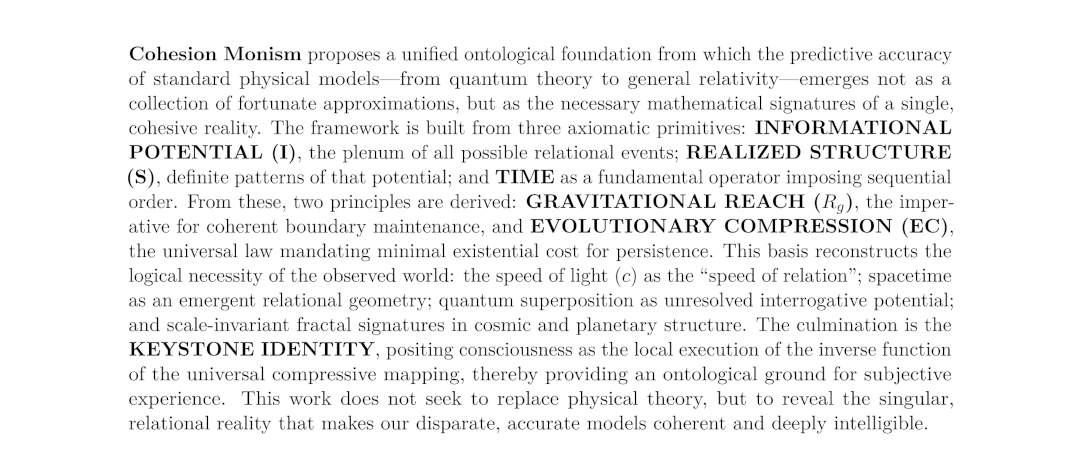 Cohesion Monism proposes a unified ontological foundation from which the predictive accuracy of standard physical models—from quantum theory to general relativity—emerges not as a collection of fortunate approximations, but as the necessary mathematical signatures of a single, cohesive reality. The framework is built from three axiomatic primitives: INFORMATIONAL POTENTIAL (I), the plenum of all possible relational events; REALIZED STRUCTURE (S), definite patterns of that potential; and TIME as a fundamental operator imposing sequential order. From these, two principles are derived: GRAVITATIONAL REACH (Rg), the imperative for coherent boundary maintenance, and EVOLUTIONARY COMPRESSION (EC), the universal law mandating minimal existential cost for persistence. This basis reconstructs the logical necessity of the observed world: the speed of light (c) as the "speed of relation"; spacetime as an emergent relational geometry; quantum superposition as unresolved interrogative potential; and scale-invariant fractal signatures in cosmic and planetary structure.
Abstract
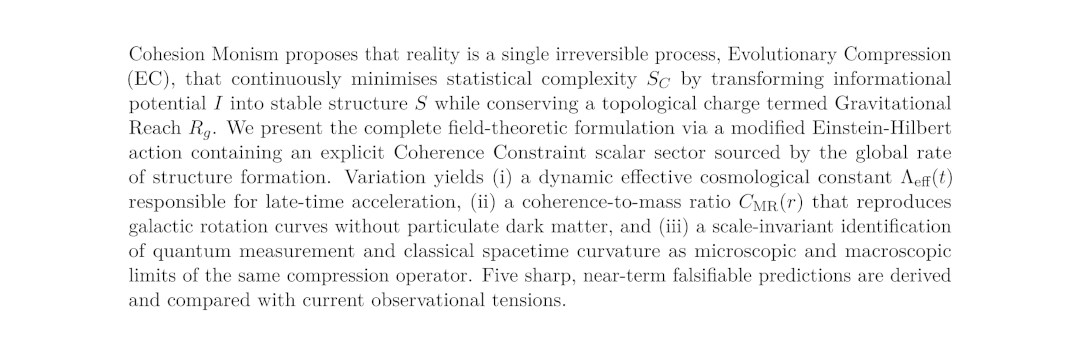 Cohesion Monism proposes that reality is a single irreversible process, Evolutionary Compression (EC), that continuously minimises statistical complexity (SC) by transforming informational potential (I) into stable structure (S) while conserving a topological charge termed Gravitational Reach (Rg). We present the complete field-theoretic formulation via a modified Einstein-Hilbert action containing an explicit Coherence Constraint scalar sector sourced by the global rate of structure formation.
Abstract
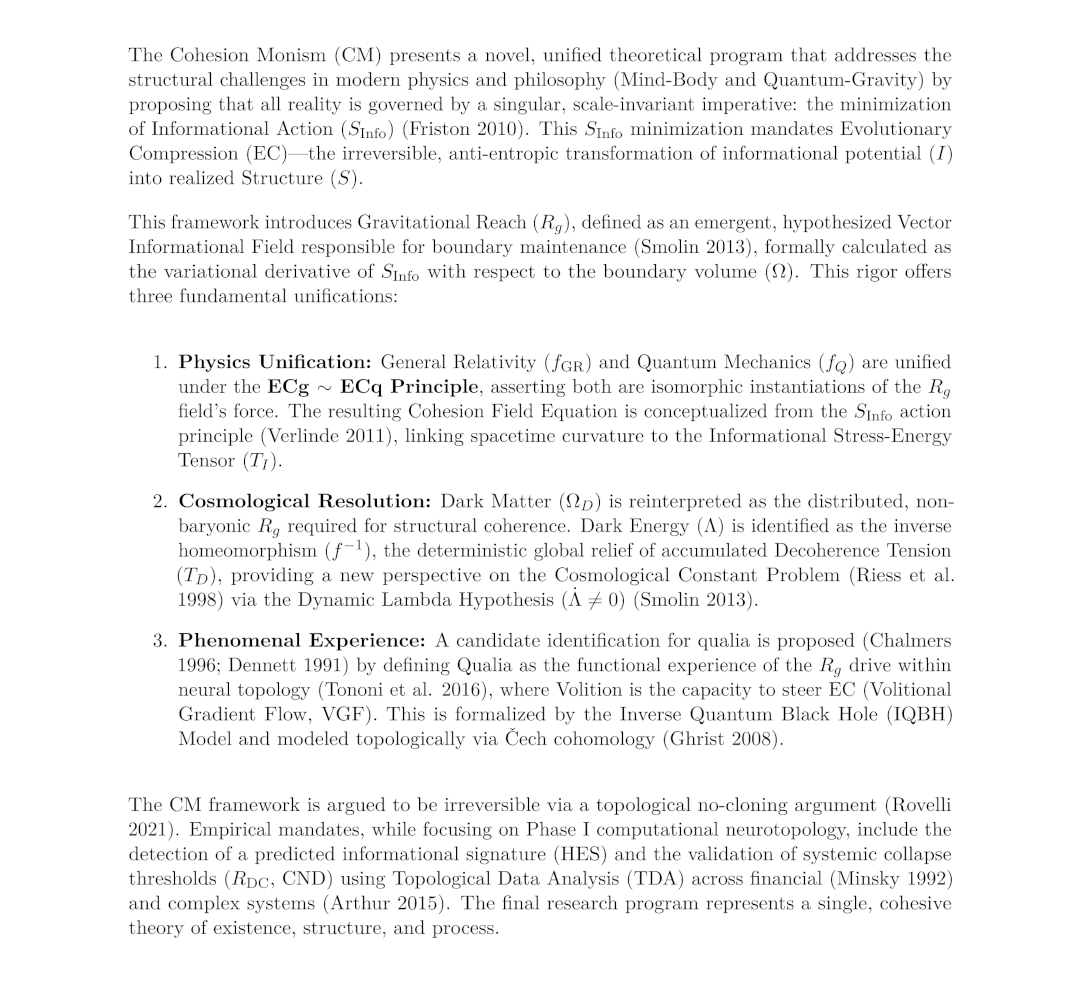 The Cohesion Monism (CM) presents a novel, unified theoretical program that addresses the structural challenges in modern physics and philosophy (Mind-Body and Quantum-Gravity) by proposing that all reality is governed by a singular, scale-invariant imperative: the minimization of Informational Action (SInfo) (Friston 2010). This SInfo minimization mandates Evolutionary Compression (EC)—the irreversible, anti-entropic transformation of informational potential (I) into realized Structure (S). This framework introduces Gravitational Reach (Rg), defined as an emergent, hypothesized Vector Informational Field responsible for boundary maintenance (Smolin 2013), formally calculated as the variational derivative of SInfo with respect to the boundary volume (Ω).
Abstract
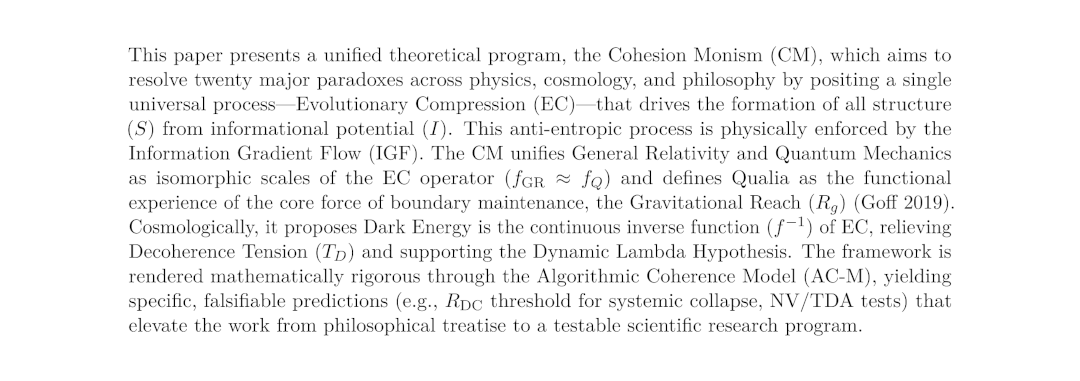 This paper presents a unified theoretical program, the Cohesion Monism (CM), which aims to resolve twenty major paradoxes across physics, cosmology, and philosophy by positing a single universal process—Evolutionary Compression (EC)—that drives the formation of all structure (S) from informational potential (I). This anti-entropic process is physically enforced by the Information Gradient Flow (IGF). The CM unifies General Relativity and Quantum Mechanics as isomorphic scales of the EC operator (fGR ≈ fQ) and defines Qualia as the functional experience of the core force of boundary maintenance, the Gravitational Reach (Rg) (Goff 2019).
Abstract
 The Cohesion Monism (CM) posits reality as a unified, process-based system minimizing Statistical Complexity (SC). This paper formally applies the CM via its core mechanism, Gravitational Reach (Rg), the fundamental force of boundary maintenance. Rg provides scale-invariant solutions: substituting for Dark Matter cosmologically, and underpinning the Inverse Quantum Black Hole (IQBH) model informationally. The framework is anchored by a postulated 10^28 compression cost and governed by the 1.5 Temporal Ratio. From these foundations, the CM presents explicit, quantifiable predictions.
Abstract
 Volume IV completes the theoretical foundation of the Cohesion Monism (CM) by resolving the paradoxical boundary conditions of Evolutionary Compression (EC). The origin point is defined as the Informational Singularity (Σ): a state of Maximal Symmetric Informational Potential where Statistical Complexity (SC = 0) due to perfect symmetry. The core mechanism is the Rg Conservation Principle, which states that the total coherence (Rg) is conserved by the topological structure of the manifold. This principle manifests as the Coherence Constraint (Cco), which is the inherent topological law preventing EC from reaching the Zero-Bound (Z−B) (the collapse to a non-compact, trivial manifold). The Cco thus solves the Cosmological Constant Problem by dynamically sourcing the expansive Decoherence Tension (TD) required to maintain topological compactness.
Abstract
 Volume V formalizes the Topological Transition Mechanics (TTM) of the Cohesion Monism (CM) Framework, proposing a model for post-biological persistence as the conservation of individual information within orthogonal topological space. This volume introduces the Rg Inversion Principle to define the collapse of the living Cohesion Monad (ΩC) and its mandatory dispersal into the Orthogonal Sectors of the Extended Phase Space. The core mechanism (Rg → −Rg inversion) is explored via a controlled quantum simulation protocol, providing a test for informational conservation in open systems.
Abstract
Panpsychism’s combination problem questions how micro-level proto-conscious states
integrate into unified macro-experiences. Analytic idealism, per Kastrup, faces a causation
challenge: how dissociated mental processes yield consistent physical-like effects without
epiphenomenalism or overdetermination. This paper argues that a topological model of
emergence, grounded in sheaf theory, offers a novel resolution. Reality is a hierarchical
structure where local relations glue into global emergents via continuous functors. An
“inverse function” enables bidirectional causality as probabilistic attractors; an “inverse
black hole” heuristic captures information compression into singular qualia. For
panpsychism, compression bypasses combination; for idealism, inverse mappings ensure
non-redundant causation. Engaging Goff, Coleman, Schaffer, and Kastrup, the model draws
empirical support from DNA’s evolutionary compression and yields testable predictions in
quantum biology. While introducing costs like mathematical abstraction, it advances
metaphysical consilience. This revised version incorporates critiques for enhanced
accessibility, empirical depth, and streamlined structure, addressing potential concerns
about over-complication and phenomenology.
Abstract
The entries on this page represent independent observational and experimental data from the world’s leading laboratories and telescopes. Each entry is interpreted through the specific coordinates of the Findlay Framework Pentalogy.
Abstract
The history of physics demonstrates that a persistent, multi-decade anomaly is rarely
a failure of observation; it is a pointer to an undiscovered law. Disparate anomalies
collectively point toward a universe where matter is historically collapsed potential. The
Findlay Framework (Part Two) provides the empirical alignments for 27 systemic anomalies
— spanning neutrino oscillations (Ahmad et al. 2002), gravitational wave backgrounds
(NANOGrav Collaboration 2023), wide binary kinematics (Hernandez et al. 2024), biological quantum coherence (Scholes et al. 2011), millisecond quantum phase coherence (Bland
et al. 2025), early galaxy confirmation (Labb´e et al. 2023), and the Cambrian Explosion
temporal address (ICS 2025) — viewed through the lens of a Relational Ontology governed
by the materialization ratio r = 1.5 (Findlay 2026a). Where Part One resolved 32 classical
paradoxes, Part Two demonstrates that active observational programs across eight orders
of scale are converging on the same geometric operator, connecting quantum measurement
to cosmological structure through a single scale-invariant transition ratio (Findlay 2026b) (Abstract count corrected — see the Addenda, entry 1.6.)
Abstract
The pre-registered GAIA DR4 wide-binary prediction record of the Findlay Framework: a velocity enhancement of √1.5 ≈ 1.2247, locked October 1, 2026, and tested against Gaia DR4 on December 2, 2026. Protocol Version 5, October 25, 2026.
12 Key Takeaways from the Findlay Framework
-
- The universe is governed by a single geometric ratio — r = 3/2 — that contains no measured quantities, no units, and no fitted parameters. [Paper #8 — Materialization Constant, §3 "Derivation of the Materialization Ratio"]
- This one constant derives the electron mass (error 0.002%), the iron mandate (364/26 = 14.000 exactly), and the fine structure constant's integer value (17 × 8 + 1 = 137) from pure geometry alone. [Paper #4 — Atomic to Consciousness Bridge, §5.7 "The Electron Mass Derivation", §5.8 "The Iron Mandate Closed", §5.10 "The Fine Structure Constant Derivation"]
- The same ratio predicts wide binary stars move √1.5 ≈ 1.225 times faster than Newton allows — a hard falsifiable prediction awaiting confirmation by GAIA DR4 on December 2, 2026. [Paper #21 — Empirical Validations Part Two, Record 003 "Hernandez Anomaly (Wide Binaries)"]
- The Framework’s empirical-validation program spans eight physical domains. The previous cumulative-significance and completed-GAIA-DR4 claims are withdrawn; see the Findlay Framework Addenda, entries 2.1, 2.2, and 3.1.
- 32 classical paradoxes of physics and philosophy — including wave-particle duality, the measurement problem, and the black hole information paradox — receive proposed resolutions without new assumptions.
- 30 active astrophysical anomalies — including the Hubble tension, JWST early galaxies, dark energy evolution, and millisecond quantum coherence — interpreted through the same geometric operator. Empirical Validations Part Two [Paper #21 — Empirical Validations Part Two, Section II "30 Empirical Validation Records"]
- Blueprint Drawing 10, drawn and copyrighted in 2016, set out the architecture of early galaxy formation five years before the James Webb Space Telescope was launched. [Paper #21 — Empirical Validations Part Two, Record 025 "Temporal Ladder Prior Art — Early Galaxy Architecture"]
- The Big Synch reframes the origin of the universe not as an explosion but as a geometric phase lock — every particle simultaneously synchronizing to a universal clock at 10¹⁴ Hz. [Paper #3 — The Big Synch, §1.3 "The Synchronization Event"]
- The framework proposes a derivation of the Standard Model’s complete particle inventory — 12 fermions, 4 bosons, 8 gluons, 6 quark flavors — directly from the structural element counts of the cube. [Paper #4 — Atomic to Consciousness Bridge, §5.1 "The Standard Model as Cube Inventory"]
- Human biology is not accidental: gestation period, chromosomal count, ATP energy charge, and the 40 Hz gamma binding cycle are all geometric requirements of the same ratio that governs galaxies. [Paper #6 — 3:2 Ratio in Human Biology, §6 Conclusion; Paper #5 — Gestation-Cosmos Invariant, §4; Paper #1 — Information as Fundamental Substance, §4.3]
- Consciousness is not separate from physics: it is the inverse half of the same fundamental spatial unit whose forward half constitutes the observable physical universe. [Paper #4 — Atomic to Consciousness Bridge, §8 "Consciousness and Observer Architecture"]
- The Framework spans 21 papers, 142 active corpus records, and 50 years of development, formalized through a five-node AI research collaboration beginning in 2025. [Corpus Index]